By Jake Einspinner, GZ Australia. Updated 26 October 2026.
A DTF transfer that cracks, fades or lifts has usually failed in one of four places. The white layer, the powder cure, the film, or the press. None of them is luck. GZ Australia's Pixy T2, T4 and T5 lines are built around the first three. The fourth is covered in hands-on training at every install. Here's what that looks like in practice.
Where does a DTF print usually go wrong?
- A thin or patchy white layer.
The colour looks dull on dark fabric and the edges show through.
- Powder that isn't fully cured.
The transfer feels fine on day one and lets go after a few washes.
- Film that wrinkles or steps unevenly.
You get banding lines and soft detail.
- The wrong press time, temperature or pressure.
Even a perfect transfer won't bond.
The first three are the printer and shaker's job. The fourth is yours, which is why training is part of every install.
How does a Pixy keep the white layer consistent?
In DTF the colour prints first and the white prints last, so the white ends up as the base between your design and the garment. That layer is what makes a print pop on a black hoodie. It's also the hardest ink in the machine to keep right, because white pigment is heavy and settles if it sits still.
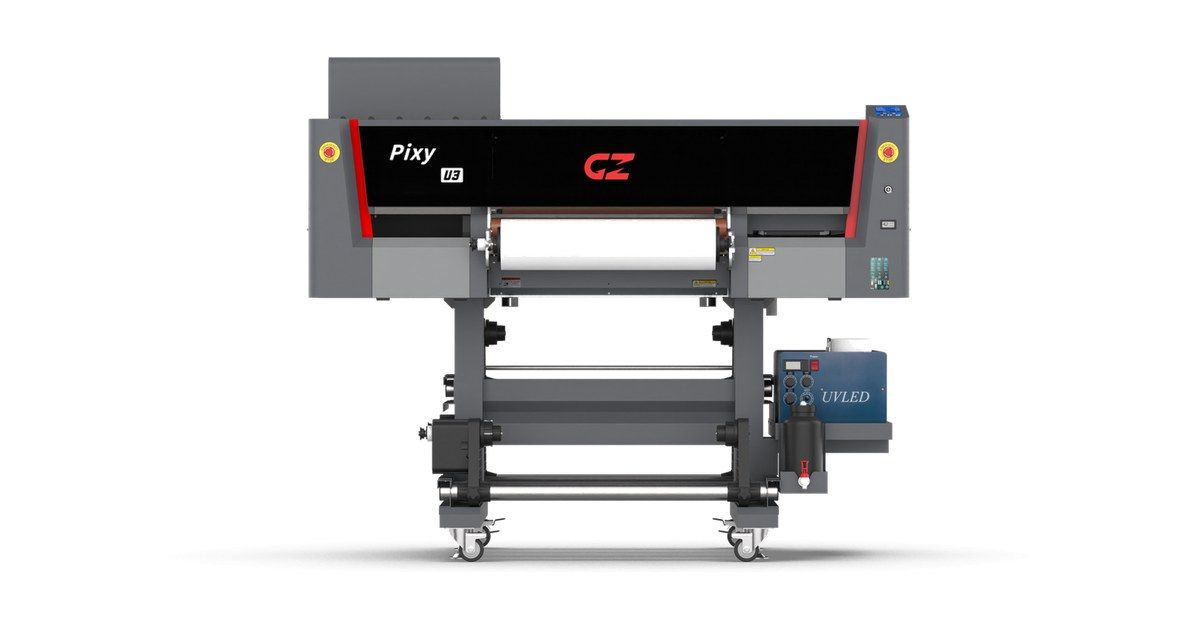
The Pixy T2
has a white ink stabilising system that includes a built-in ink-shaking kit and white ink recirculation, so the white keeps moving and stays mixed. The Pixy T4
and Pixy T5
run two dedicated white heads with white ink circulation, so there's more white going down on every pass. A white that stays mixed is what keeps the density steady from one job to the next.
Why does the powder cure matter so much?
The bond between transfer and fabric is a hot-melt adhesive powder. It's shaken onto the wet white ink, the excess comes off, and the rest is melted into an even layer in the dryer. Under-cure it and the transfer peels. Over-cook it and it goes brittle.
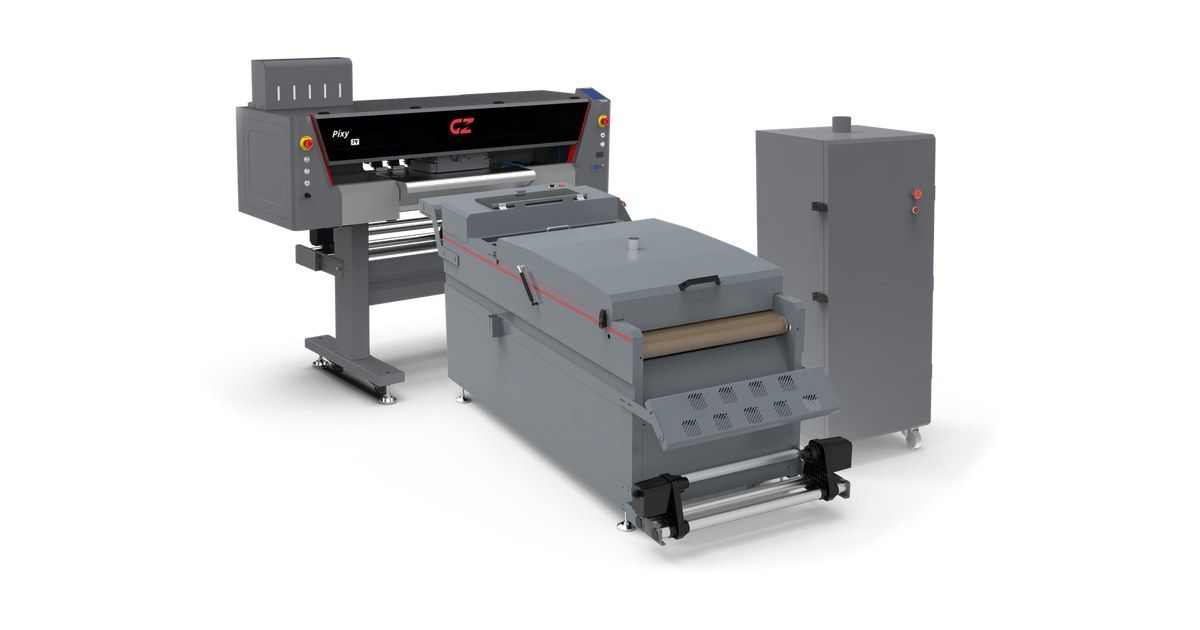
That's why every Pixy is sold as a complete line, printer, shaker and dryer matched together, rather than a printer and a pile of accessories. The T2 comes with the Pixy SK2 shaker, which dries with double-sided lamps and an air-cooling fan, and has its fume filter built in rather than in a separate cabinet. The whole T2 line runs off one standard 15A plug: the printer draws 3A and the shaker 11A. The T4 and T5 lines pair with larger shakers built for their higher output.
Every Australian T2 also comes with the EU-standard safety kit as standard. The factory lists it as an option.
What stops banding and soft detail?
Film handling. If the film wrinkles, or steps forward a fraction too far between passes, you see it as lines across the print. The Pixy lines use an active tension bar that keeps the film at constant tension, so it stays flat and steps precisely. The carriage runs on THK linear guides and an Igus cable chain, on an aluminium beam built not to flex.
Then the heads. Every Pixy DTF printer runs Epson i3200-A1 heads, each with 3,200 nozzles at a native 600dpi. In six-pass mode they print at 720 x 1800dpi, which is where fine type, thin outlines and gradients hold their edges. The T2 runs two heads, the T4 four, and the T5 five.
Does the ink make a difference?
Yes, because the ink, the heads and the white system are designed to work together. The T2 runs the factory's PT5 DTF textile pigment ink, and the T4 and T5 run its original transfer pigment ink. GZ Australia supplies that ink, film and adhesive powder for the machines we sell, so the consumables you run are the ones the printer was set up and trained on.
What does GZ do that the spec sheet doesn't show?
The press. A DTF transfer only holds up if it's pressed at the right temperature, pressure and time, and peeled the right way for the film. We cover it at install, hands-on, on your own machine, so you're producing from day one.
After that you deal with the same people who installed it. Our technicians are in Sydney, Melbourne, Perth and Queensland, and every machine carries a 2-year machine warranty. Parts that touch ink, like heads and dampers, are wear items with their own shorter cover, and the warranty page spells that out plainly.
Which Pixy DTF line is right for you?
| Line |
Heads |
Shaker |
Rated speed |
Cost (ex GST) |
| Pixy T2 + SK2
|
2 x Epson i3200-A1
|
SK2, filter built in
|
15 m/h (4 pass)
|
$27,990
|
| Pixy T4
|
4 x Epson i3200-A1
|
Four-row lamp shaker
|
30 m/h (4 pass)
|
$32,990
|
| Pixy T5
|
5 x Epson i3200-A1
|
SK5
|
28 m/h (6 pass)
|
$37,990
|
All three print on 60cm film. Prices are AUD, ex GST (10% on top) and ex freight, and include installation, training and the 2-year machine warranty. A heat press is not included.
For the full model-by-model comparison, read the DTF printer buying guide. Still choosing a technology? DTF vs sublimation
covers when each one wins.
DTF print quality: common questions
Why do DTF transfers peel after washing?
Most often the adhesive powder wasn't fully cured, or the transfer was pressed at the wrong temperature, pressure or time. A matched printer, shaker and dryer fixes the first, and press training fixes the second.
Why does my DTF print look dull on black shirts?
The white layer is too thin or uneven. White ink settles when it sits still, so it needs to be kept moving. Pixy DTF printers use white ink recirculation, and the T2 adds a built-in ink-shaking kit.
What printheads do GZ Australia's DTF printers use?
Epson i3200-A1 heads: two on the Pixy T2, four on the T4 and five on the T5. They print up to 720 x 1800dpi in six-pass mode.
Do DTF prints stretch?
A properly cured DTF transfer stretches with the fabric, which is why DTF works on activewear as well as cotton tees.
What does a DTF printer cost in Australia?
GZ Australia's Pixy DTF lines cost $27,990 ex GST (T2 with SK2 shaker), $32,990 ex GST (T4) and $37,990 ex GST (T5). Installation, training and a 2-year machine warranty are included.